The 2026 vintage will be remembered as a very early, extremely hot year, yet paradoxically one with better water supply than the two previous growing seasons. It was shaped by a particularly sharp contrast: an exceptionally wet winter replenished water reserves, followed by a warm spring with a rainfall deficit. The summer, for its part, was marked by several heatwaves and severe drought.
The 2025-2026 winter played a decisive role in the resilience of the vineyard. In Occitanie, winter rainfall reached roughly twice the normal level. Remarkable totals were recorded, exceeding 500 mm, and water surpluses reached 150% in the main areas.
This recharge was decisive: it allowed deep soils, or those with good water-holding capacity, to better withstand the summer drought.
By contrast, shallower, stony or clay-rich areas gradually fell behind from August onwards. Yield variability thus became one of the defining characteristics of the vintage.
Spring was then very hot and relatively dry, with the highest temperatures recorded in France since 1900, a temperature anomaly of around +1.8 °C and a rainfall deficit of about 25%.
The situation became markedly more strained from June onwards. June 2026 was the hottest June ever recorded in France, at +3.8 °C above normal, with a rainfall deficit close to 50%. Around the Mediterranean, June totals were often below 10 mm. In Nîmes and Montpellier, more than 25 very sunny days were recorded in that month alone.
This pattern continued into July and August, with record rainfall deficits. Several heatwaves also followed one after another, intensifying vine water stress, particularly on free-draining soils and in young plantings.
A particularly early harvest calendar
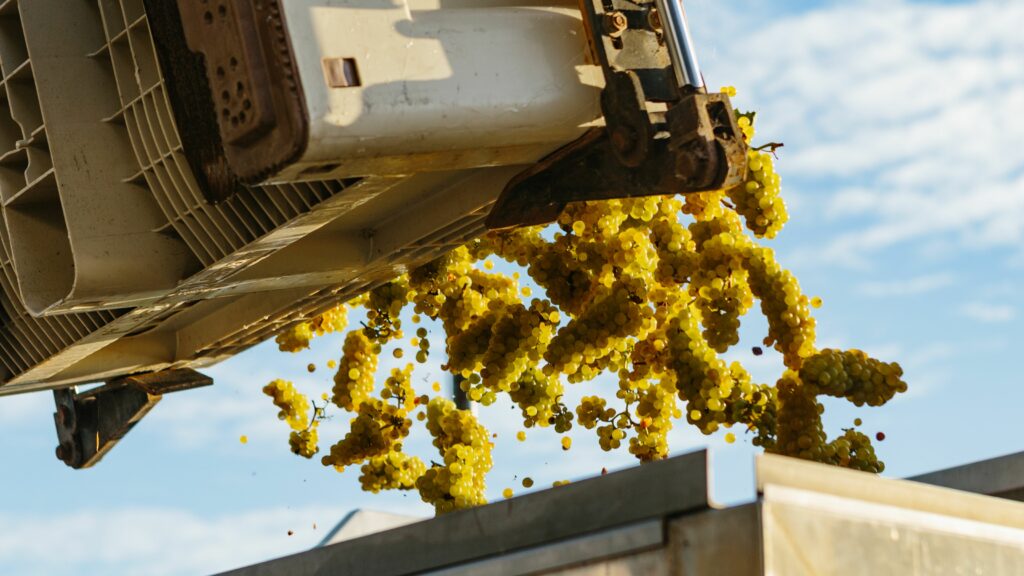
The vine growth cycle was considerably accelerated. The first grapes were picked at the end of July in the earliest-ripening areas, after which the schedule tightened up until the end of the season.
A rain event, of varying intensity depending on the area, occurred at the end of August and marked a break in the course of the harvest. Most of the whites and rosés had already been picked. The reds, for their part, benefited from this fresh supply of water, which helped ripening to resume. The most striking feature of this end of the cycle, however, remains the sudden narrowing of the harvest window.
Technological ripeness was reached very early but, unlike in previous years, phenolic ripeness was slow to come on the reds.
Harvests in the Languedoc thus finished up to nearly three weeks earlier than the usual benchmarks, with more shrivelling than usual on the last plots picked.
On the health front, however, the outcome is very favourable across most of the vineyard: the absence of regular summer rainfall greatly limited disease pressure, and the grapes arriving at the winery are generally very healthy.
1. CORBIÈRES AREA
The Corbières benefited from an exceptional winter water recharge. Durban-Corbières in particular recorded around 737 mm during the 2025-2026 winter, a particularly high level. This reserve was a genuine water bank for the vineyard as it entered the summer.
The hot, dry spring followed by the heatwaves of June and July nevertheless quickly drew heavily on the soils. Shallow plots, or those with low storage capacity, suffered marked water stress, while areas with deeper soils maintained better vine growth and function.
Harvesting began very early. In the Famille Fabre vineyards in the Corbières, the first Chardonnay was picked as early as 7 August, and the Merlot destined for rosé from 11 August. The winter water reserves made it possible to obtain grapes of very fine quality, with attractive aromatic potential.
For the Corbières, the volume challenge is also tied to the reduction in planted area and to the lingering effects of the setbacks of previous seasons, particularly in the areas hit by the 2025 fire.
2. MINERVOIS AREA
The Minervois went through the same general sequence: a very wet winter, a hot, dry spring, then a scorching summer.
The exceptional nature of 2026 is particularly pronounced in the Minervois: some plots reached maturity before the earlier-ripening areas that are usually harvested first. By 20 August, plots in the appellation were already ready to be picked.
Overall potential is higher than in 2025 on plots that benefited from the winter recharge, but with wide variability from plot to plot.
The main challenge was therefore not just average yield, but the ability to preserve berry weight through to harvest. In terms of quality, the La Livinière area is very interesting: deep colour, lovely freshness and particularly elegant Carignans. Some Syrahs have also shown attractive aromatic profiles.
3. LA CLAPE AREA
La Clape experienced the same episodes of heat and drought as the Narbonne coastline, but its maritime setting acts as an important moderating factor. The massif benefits from regular winds and maritime influences, with structurally low rainfall.
The 2026 conditions therefore favoured very rapid ripening while, in some plots, preserving a sense of freshness linked to the maritime influence and the wind regime.
The high humidity seen during the summer period helped limit water stress on the vines and preserve the full aromatic potential of the grapes.
For the whites, and in particular La Clape’s traditional grape varieties, led by Bourboulenc, controlling the harvest date was especially important to avoid any loss of freshness. The area is regaining some ground in terms of volume after a very small 2025, thanks to the winter water reserves and the maritime influence over the summer.
4. NARBONNE – BÉZIERS PLAN AREA
This is probably one of the earliest areas for the 2026 vintage.
In the Biterrois, harvesting began as early as 3 August. It was ultimately characterised by great earliness, but also by generous yields and excellent health status. Plain soils that retained a significant share of the winter recharge held up better than some of the hillsides.
The area was marked by exceptional weather events, from the fires in July to very violent winds in the middle of the harvest.
These events did not, however, affect the quality of our partners’ grapes.
5. PICPOUL DE PINET AREA
Picpoul is a special case in the 2026 vintage. The proximity of the Étang de Thau and the maritime influence helped to differentiate plots sharply. The summer drought slowed ripening in some areas.
The storm of 25 August played a decisive role: it restarted some vines that had stalled and triggered an acceleration in ripening. Harvesting finished in early September for this variety, which makes it one of the latest-ripening whites in the Languedoc.
Plots close to the Étang better retained their acidity. This difference in ripeness between plots made analytical checks, and above all berry tasting, essential.
The winter water reserves and the humidity brought by the Étang enabled the appellation to recover more substantial volumes than in previous years.
6. TERRASSES DU LARZAC AREA
In Montpeyroux, harvesting began on 13 August, six days earlier than in 2025, which was already a record year for earliness. The area had also experienced a particularly wet winter, with the highest totals recorded locally since 2009.
The vintage highlights in particular the value of high-altitude terroirs and sites that benefit from cooler nights. The winter water reserves allowed old vines and deep soils to better withstand the succession of heatwaves.
Very fine quality potential. The diurnal temperature range helped preserve the freshness and aromatic complexity of the grapes. The high temperatures, for their part, favoured concentration and phenolic ripeness.
The expected profile is one of concentrated yet potentially balanced reds, provided extraction is well managed. Only the varieties planted on clay soils struggled to cope with the high temperatures of September.
7. PIC SAINT-LOUP AREA
Pic Saint-Loup is among the areas that benefited most from the winter recharge. Its terroir is usually characterised by higher rainfall than the rest of the Languedoc and by large temperature swings between day and night.
In 2026, these characteristics proved an advantage, but did not cancel out the effects of the summer drought. The vintage showed a disparity between deep soils and shallow hillsides. The best plots maintained satisfactory vegetative activity, while the poorer areas experienced advanced water stress.
Both quality and quantity potential are very good across the whole appellation, with the exception of the Lauret area, which was hit by a hailstorm in early July.
8. SAINT-CHRISTOL AREA
Saint-Christol lies in an intermediate zone between Montpellier and Nîmes, at 50-100 metres above sea level, with the influence of sea breezes. Its terroir of rolled pebbles naturally favours good ripeness.
This year, the area benefited, like the rest of the Languedoc, from the winter recharge, but the pebbles and free-draining soils then amplified water constraints over the course of the summer.
Ripeness potential was very high. The vintage required close monitoring of the Grenache and Syrah to avoid a rapid tipping over into overripeness.
In the end, potential is higher than in 2025 on plots that had enough water, but probably lower than historical benchmarks on the most free-draining soils.
As every year, this is the area that produces the most concentrated wines, which fit well with the range offered by our partner.
9. CAMARGUE AREA
The Vauvert/Petite Camargue area was subjected to very strong heat and water stress during the summer. The proximity of the Camargue nevertheless brings maritime influences and air circulation that limited some of the effects of the heat. Harvesting was early, as across the whole of the Gard. Soil response was highly contrasted: areas with a good water reserve retained more potential. Conversely, shallow plots were more affected by shrivelling and loss of berry weight.
Volume potential looks very promising, an improvement on the very small previous crop.
Of note is a hailstorm in spring in the area south of Beaucaire, which may have affected final yields.
10. CÉVENNES AREA
The Cévennes area benefited from historically favourable water conditions coming out of winter, before undergoing the same shift towards drought and heat.
In the Gard, harvesting began as early as 5 August in the Piémont Causses & Cévennes area. The first Floréal grapes were picked before 10 August, nearly a month earlier than fifty years ago.
The area south of Alès experienced higher temperatures than the rest of the Languedoc during the ripening period. Water reserves, closer to normal than in areas more accustomed to drought, such as the Aude, were nevertheless quickly drawn upon. In this context, volume potential remains close to last year’s.
The area was also marked by an intense and highly localised hailstorm in August.
CONCLUSION
The 2026 vintage should not be summed up as simply a “hot vintage”. Its true defining feature is the contrast between an exceptional winter water supply and a succession of extreme heat episodes during the growing cycle. The winter gave the vineyard the water capital it needed to avoid a repeat of 2025 and its low yields. But this reserve was not sufficient everywhere: shallow soils fell behind much more quickly than deep soils, creating considerable variability at plot level.
As of 1 September, Agreste estimated the Languedoc-Roussillon harvest to be up around 5% on 2025, but still around 8% below the 2021-2025 average. This estimate remains provisional.
The summer drought strongly limited pressure from the main diseases. Grapes generally arrived at the winery in healthy condition. The main risk was not rot but rather shrivelling, excessive concentration and accelerated ripening.
This was a vintage that demanded great responsiveness at critical moments and careful management of inputs in the cellar.
High-altitude areas, deep soils, and plots benefiting from maritime influences or cooler nights better preserved their balance. Conversely, shallow, very stony or highly free-draining soils suffered more from the drought.
From an oenological standpoint, early feedback points to a vintage with plenty of body and colour in the early-ripening reds (Syrah), sometimes high alcohol levels, but also surprisingly well-preserved acidity in the best terroirs. For the whites and rosés, particular attention will need to be paid to freshness and acidity balance.
Finally, the 2026 vintage will have profoundly changed the calendar benchmarks: some harvests began at the end of July, harvest windows narrowed considerably, and the traditional order of whites, rosés and reds was at times turned upside down.
This highly unusual vintage required a great deal of preparation and responsiveness from our winemaking partners in order to preserve the consistency of the profiles we offer.